profilora.com – Marie Curie biography is a remarkable tale of determination and brilliance. Born in Poland in 1867, she overcame numerous obstacles to become one of the most celebrated scientists in history. Curie’s groundbreaking work in radioactivity changed the landscape of modern physics and chemistry. She was the first woman to win a Nobel Prize and remains the only person to win Nobel Prizes in two different scientific fields. Her extraordinary achievements not only paved the way for future generations of women in science but also contributed significantly to medical advancements and our understanding of atomic energy.
The Early Life of Marie Curie
Marie Curie was born Maria Skłodowska in Warsaw, Poland. She was the youngest of five children in a family dedicated to education. Her father was a schoolteacher who instilled in her a love for learning. Despite facing hardships, including the loss of her mother at a young age, she excelled academically. In 1891, she moved to Paris to pursue her studies at the University of Paris, where she adopted the name Marie.
During her time at university, Curie faced significant challenges. She was often discriminated against for being a woman in a male-dominated field. Nevertheless, her passion for science kept her motivated. She earned degrees in physics and mathematics, laying the foundation for her future discoveries. In 1895, she married Pierre Curie, a fellow scientist who became her partner in research. Together, they embarked on groundbreaking studies in radioactivity, a term that Curie herself coined.
Groundbreaking Discoveries in Radioactivity
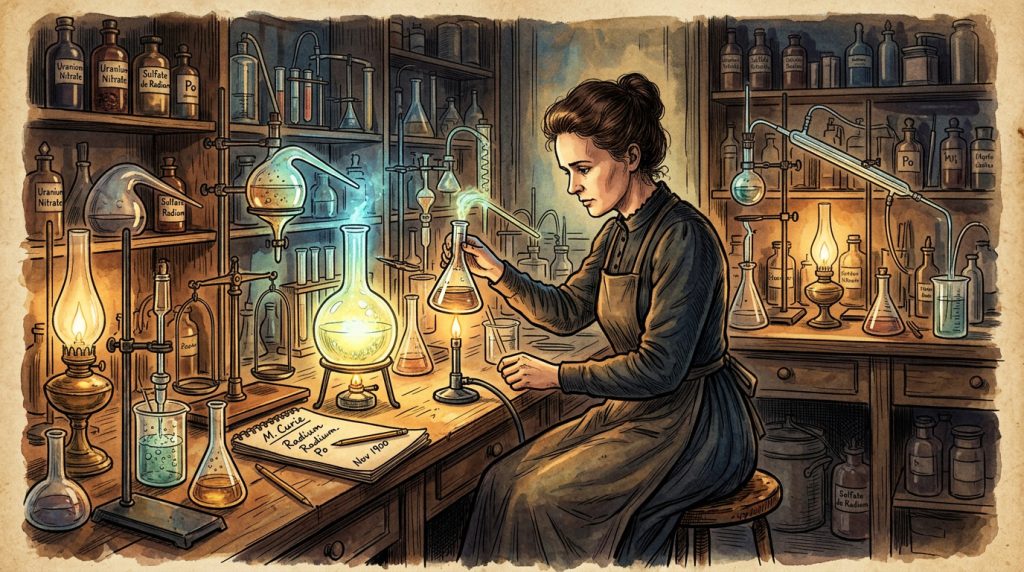
Marie Curie’s most significant contributions to science came through her research on radioactivity. In 1898, she and her husband discovered two new elements: polonium and radium. These discoveries were pivotal in understanding atomic structure and radiation. Curie’s meticulous experiments demonstrated the link between radioactivity and the properties of atoms. Her work challenged existing theories and opened new avenues in both physics and chemistry.
In 1903, Marie Curie shared the Nobel Prize in Physics with Pierre Curie and Henri Becquerel for their work on radioactivity. This recognition was a monumental achievement for women in science, inspiring countless others. After Pierre’s tragic death in 1906, Marie continued her work alone, eventually earning a second Nobel Prize in Chemistry in 1911 for her isolated radium. Her relentless pursuit of knowledge and her groundbreaking discoveries solidified her legacy in the scientific community.
Tips/Insight
Marie Curie’s life offers valuable insights for aspiring scientists. First, embrace challenges and persist in the face of adversity. Curie’s journey exemplifies resilience and determination. Additionally, collaboration can enhance your research. Her partnership with Pierre Curie led to significant breakthroughs. Lastly, never underestimate the impact of education. Curie’s commitment to learning fueled her extraordinary achievements.
Conclusion
In summary, the Marie Curie biography is not just a story of scientific achievement but also one of inspiration. Her contributions transformed modern physics and paved the way for women in science. Curie’s legacy continues to influence countless individuals today. By overcoming gender barriers and challenging scientific norms, she remains a symbol of perseverance and innovation.