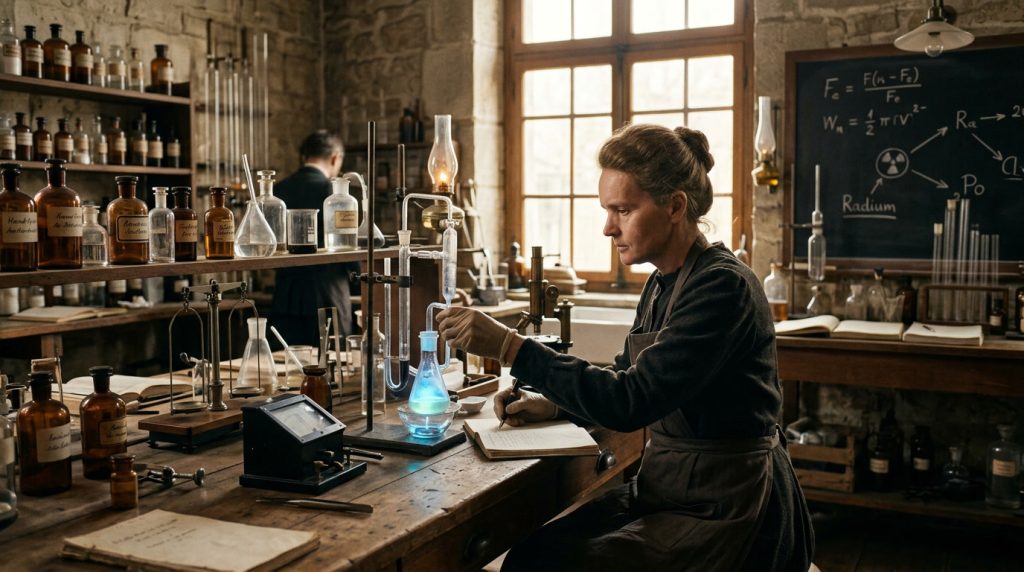
profilora.com – Marie Curie biography is a story of pioneering spirit and scientific achievements. She was the first woman to win a Nobel Prize, a feat that marked a significant milestone in science and gender equality. Born in Warsaw, Poland, Curie’s journey in science led her to discover radioactivity and two elements, polonium and radium. These discoveries not only advanced medical science but also changed the way we understand atomic physics. Her relentless pursuit of knowledge and resilience in a male-dominated field made her an icon of scientific research.
Early Life and Education
Marie Curie was born on November 7, 1867, in Warsaw. She was the youngest of five children in a family that valued education highly. Despite the challenges posed by Russian rule in Poland, Curie excelled academically. She attended the clandestine Flying University, where she studied physics and mathematics. – In 1891, she moved to Paris to continue her education at the University of Paris (Sorbonne). There, she earned degrees in physics and mathematics. Curie’s determination and hard work laid the foundation for her future discoveries.
Scientific Discoveries and Nobel Prizes
Marie Curie’s groundbreaking work began in the late 19th century. In 1898, she and her husband, Pierre Curie, discovered two new radioactive elements: polonium and radium. Their research on radioactivity opened new horizons in medical treatment and scientific research. In 1903, Marie Curie became the first woman to win a Nobel Prize in Physics, sharing the honor with her husband and Henri Becquerel. Later, in 1911, she won a second Nobel Prize, this time in Chemistry, for her work on radium and polonium. Her contributions to science were immense and continue to influence research today.
Tips/Insight
Marie Curie’s life teaches us several valuable lessons. First, perseverance is key in any field, especially in science. Curie faced numerous obstacles, including gender bias and health issues. Despite this, she remained committed to her research. Second, collaboration can lead to significant discoveries. Working with her husband, Pierre, Curie achieved remarkable results that changed science forever. Lastly, education is vital. Curie’s extensive knowledge allowed her to make groundbreaking contributions. Aspiring scientists can draw inspiration from her life and work ethic.
Conclusion
In summary, the Marie Curie biography showcases her extraordinary contributions to science and society. Her legacy as the first woman to win a Nobel Prize continues to inspire generations. Curie’s discoveries have had lasting impacts on various fields, including medicine and physics. Her story is a testament to the power of determination and intellect in overcoming challenges.