When Albert Einstein spoke, people often expected formulas. What they got instead were parables about curiosity, justice, and imagination. He never considered himself a genius, yet his mind changed how humanity understands time, space, and the moral duty of intellect. To Einstein, equations were poetry written in the language of the universe — and his life, from a wandering child in Germany to a quiet figure in Princeton, was an experiment in freedom itself.
Early Life and the Spark of Wonder
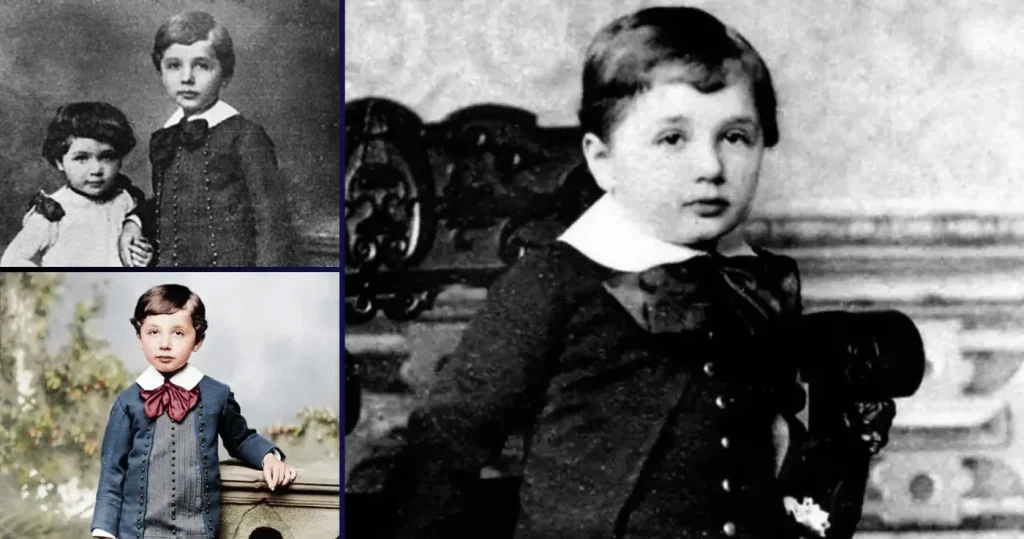
Albert Einstein was born on March 14, 1879, in Ulm, Germany, to Hermann and Pauline Einstein — a modest family running a small electrical business. As a child, he spoke late, preferred solitude, and seemed endlessly fascinated by invisible forces. When he was five, his father gave him a simple compass. Watching the needle twitch without any visible cause awakened a lifelong question: What makes nature move?
Einstein’s school years were uneasy. Rigid classrooms and memorization clashed with his restless curiosity. One teacher in Munich famously told him he “would never amount to anything.” But at home, his mother played piano, his father loved engineering, and both encouraged independence. That freedom mattered more than grades.
At 16, he renounced his German citizenship to avoid military service, spending several years stateless. He later entered the Swiss Federal Polytechnic in Zurich, where he met Mileva Marić, a fellow physics student who shared his rebellious intellect. They married in 1903, against both families’ wishes, and soon faced the chaos of youth, poverty, and a child born out of wedlock. Between tutoring jobs and rejected applications, Einstein worked as a clerk in the Swiss Patent Office — an unlikely cradle for revolution.
The Patent Clerk Who Reshaped the Universe
In 1905, while working full-time in Bern, Einstein published four papers that detonated modern physics.
The first explained the photoelectric effect, revealing that light behaves both as wave and particle — a discovery that would earn him the Nobel Prize in 1921. Another explored Brownian motion, proving the physical existence of atoms. But his third and fourth papers changed everything: Special Relativity and E=mc², a deceptively simple equation that showed mass and energy are two sides of the same cosmic coin.
He called it his “miracle year.” To the world, it was a scientific renaissance. From the small apartment where he wrote at night while his son slept, Einstein dismantled centuries of Newtonian certainty.
By 1909, the unassuming patent clerk was appointed professor at the University of Zurich, then Prague, and later Berlin. Yet his curiosity remained irreverent. He once imagined a man falling off a roof and realized he wouldn’t feel his own weight — the thought that led to General Relativity, his most beautiful creation.
General Relativity and Global Fame
In 1915, Einstein unveiled his General Theory of Relativity, an eight-year pursuit to explain gravity not as a force but as the curvature of space-time itself. The idea was so audacious that even fellow physicists hesitated to believe it.
Four years later, in 1919, British astronomer Arthur Eddington traveled to an island off Africa to photograph a solar eclipse. When he confirmed that starlight bent exactly as Einstein predicted, the news crossed war-torn Europe like a signal flare of unity: a British scientist had proven the theory of a German-Jewish pacifist. Overnight, Einstein became a global icon — proof that reason could outshine nationalism.
By the early 1920s, America fell in love with him. Newspapers followed him everywhere, comparing him to a prophet. But Einstein remained humble, joking that “the difference between stupidity and genius is that genius has its limits.” He detested fame, calling it “a curious form of loneliness.”
He used that fame for advocacy. Touring the United States in 1921, he raised funds for the Hebrew University of Jerusalem, while writing essays defending democracy and intellectual freedom. His essays mixed science and ethics, reminding the world that “without ethical culture, there is no salvation for humanity.”
Beyond the Equation: Politics, Morality, and Dissent
Einstein’s mind was as radical in politics as in physics. He was a social democrat, a Zionist humanist, and a fierce pacifist — until pacifism itself felt inadequate against tyranny. The rise of Nazism forced him to flee Germany in 1933, after his books were burned and his name appeared on assassination lists. He settled in Princeton, New Jersey, at the newly founded Institute for Advanced Study — a refuge for displaced thinkers.
From Princeton, he spoke out against fascism, colonialism, and racial injustice. He joined the NAACP and corresponded with W.E.B. Du Bois, supporting civil rights long before it was fashionable. “I do not belong to the white race,” he once wrote, “but to the human race.”
Yet even his moral compass faced contradiction. In 1939, persuaded by colleagues who feared Hitler’s Germany, Einstein co-signed a letter urging President Franklin D. Roosevelt to research atomic energy — a warning that helped launch the Manhattan Project. Later, when Hiroshima burned, he said quietly: “Had I known, I would never have signed.”
During the McCarthy era, his defense of intellectual freedom and socialism drew FBI suspicion. The Bureau built a file nearly 1,500 pages long. Einstein called it “proof that America’s paranoia was stronger than its curiosity.”
The Man Behind the Mind: Love, Solitude, and the Quest for Unity
Einstein’s personal world was as turbulent as his theories. His first marriage to Mileva Marić collapsed under strain and distance; they divorced in 1919. That same year, he married Elsa Löwenthal, his cousin and confidante, who became his anchor through fame and frailty.
Despite global acclaim, Einstein was haunted by what he called “the failure of my great dream.” He spent his final decades chasing a Unified Field Theory — a single equation to merge gravity, electromagnetism, and quantum mechanics. The irony was poetic: the man who united the universe could not unite its laws.
His philosophical writings grew increasingly reflective. “Science can only ascertain what is,” he wrote, “but not what should be.” He warned against blind nationalism and the mechanization of human spirit. “Our technology outpaces our humanity,” he lamented, decades before it became cliché.
Even his religious outlook was complex. Though often labeled an atheist, he described his faith as “cosmic religiosity” — awe before the harmony of natural law. “I believe in Spinoza’s God,” he said, “who reveals himself in the orderly harmony of what exists, not in a God who concerns himself with the fates of men.”
The Last Equation: Einstein’s Closing Chapter
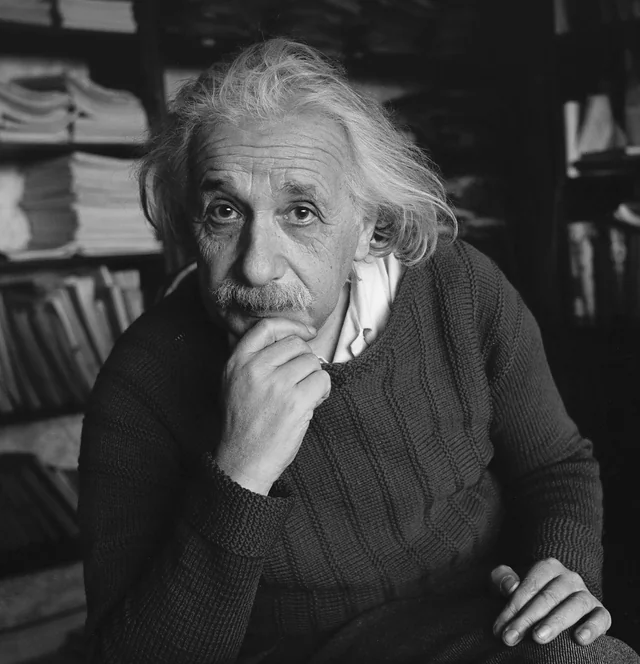
Einstein never stopped working. His small Princeton office was cluttered with papers, pipes, and music scores — he played violin daily, calling it “a way of thinking in sound.” In 1955, after refusing surgery for a ruptured aorta, he told doctors: “It is tasteless to prolong life artificially. I have done my share; it is time to go.”
He died on April 18, 1955, at age 76. The night he passed, a pathologist secretly removed his brain for study — a violation that would spark ethical debate for decades. Yet even dissected, the mystery of his genius refused to be solved.
His desk, photographed hours after his death, still bore an unfinished manuscript titled Unified Field Theory. The handwriting trailed off mid-sentence, as if the universe had simply continued his thought elsewhere.
Beyond Time: Einstein’s Enduring Legacy
Einstein’s legacy transcends physics. His theories underpin GPS navigation, nuclear energy, and modern cosmology. Gravitational waves, black holes, and quantum entanglement — all traceable to the questions he first dared to ask. But his truest influence lies in the spirit of inquiry he embodied.
He redefined genius as curiosity armed with compassion. “Imagination,” he wrote, “is more important than knowledge, for knowledge is limited.”
A century later, his wild hair and gentle smile remain shorthand for brilliance, rebellion, and wonder. From his image on posters to his equations guiding satellites, Albert Einstein endures as both myth and mirror — a reminder that intellect without empathy is incomplete.
In the growing constellation of Profilia Science Biographies, Einstein stands as the brightest paradox: the man who bent space-time yet never stopped believing that moral gravity holds the universe together.