
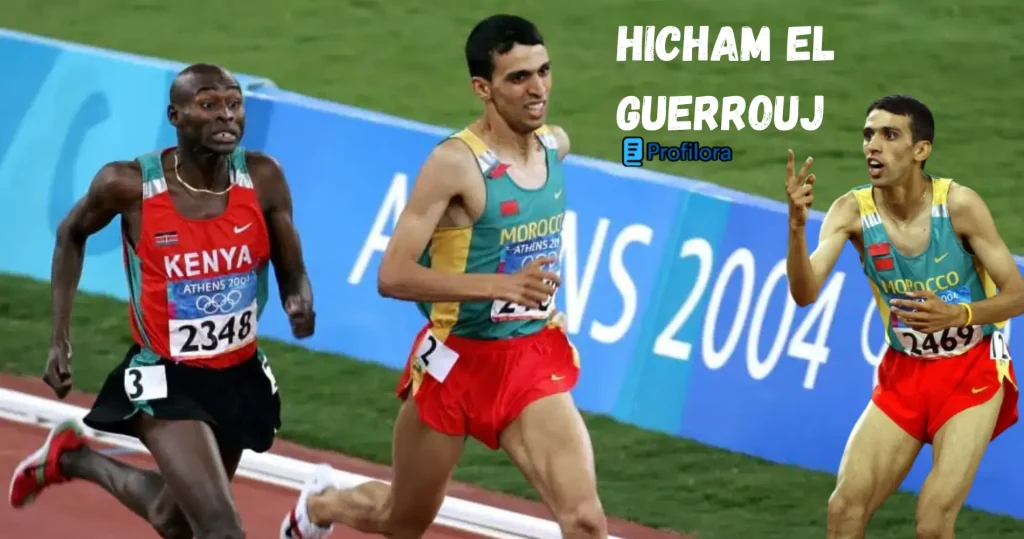
Some runners win races. Hicham El Guerrouj built a kind of spell.
He wasn’t the loudest personality in the stadium, and he didn’t need to be. His power lived in the way he moved: upright, smooth, almost polite—until the final lap arrived and the race suddenly belonged to him. Watching him at full flight was like watching a door close. Not dramatic. Just final.
For many fans, the first question is simple: Was he the fastest miler ever? The record book answers that with a clean number—3:43.13—the fastest mile time ever run outdoors, set in Rome in 1999.
But the real story is bigger than a time. It’s about a boy from Berkane who turned middle-distance running into an art form, and then—when he was tired of almost—finished his career with the one thing that had kept slipping away: Olympic gold.
- From Berkane to the Big Leagues
- The Rise of “El Guerrouj,” Not Just a Name
- The Turning Point: Rome and the Fastest Mile
- When Greatness Still Feels Incomplete
- Athens 2004: The Night He Finally Closed the Loop
- Beyond the Spotlight: Pressure, Expectations, and the Cost of Being “The Standard”
- The Human Behind the Icon
- Legacy: A Record That Still Challenges the Sport
From Berkane to the Big Leagues
El Guerrouj was born on 14 September 1974 in Berkane, Morocco.
That detail looks small on a biography page, but it matters. Berkane isn’t a glamorous sports factory. It’s a place where ambition has to be personal before it becomes public. You don’t become world-class there because the world expects it. You become world-class because something inside you refuses to settle.
His physical profile never screamed “superhuman,” which is part of the fascination. Hicham El Guerrouj height is commonly listed around 1.76 m.
In a sport obsessed with physiology, he made people talk about something else: rhythm, judgment, timing, nerve.
Middle-distance running is a cruel zone. Too long to fake, too short to recover. It rewards athletes who can suffer without looking like they’re suffering—and then unleash precision when everyone else is drowning. El Guerrouj’s gift was that he could do both: survive the grind and still sprint like the race had just begun.
The Rise of “El Guerrouj,” Not Just a Name
People search el guerrouj like it’s a single unit—one word, one legend. That’s what happens when a career becomes a shorthand for dominance.
Through the 1990s, he emerged as the man to beat at 1500 metres and the mile. These aren’t just distances; they’re personalities. The 1500 is tactical, sharp, full of traps. The mile is mythic—part measurement, part obsession. And he mastered both.
What separated him wasn’t only speed. It was control. He could turn races into equations: pace, placement, pressure, and then the final answer—his kick.
The Turning Point: Rome and the Fastest Mile
If you want the moment the world stopped arguing and started accepting, it happened in Rome.
On 7 July 1999, Hicham El Guerrouj ran 3:43.13 for the mile—recognized as the men’s mile world record and widely referenced as the fastest mile ever run outdoors.
The number is famous. The context is even better: the race was so electric that another runner, Noah Ngeny, also went under the previous world record in the same event.
That’s how you know a record is real. Not because it’s fast—lots of things are fast. It’s real because it drags greatness out of everyone around it.
And he didn’t only own the mile. The year before, in 1998, he set the 1500 metres world record: 3:26.00, also in Rome.
Two different races, two different demands, one same message: he wasn’t visiting history—he was remodeling it.
So when people type fastest mile time, they’re usually asking for the headline number. The deeper answer is that his record came from a rare mix: speed strong enough to scare sprinters, endurance strong enough to break specialists, and a racing IQ that made chaos feel orderly.
When Greatness Still Feels Incomplete
And yet—here’s the twist that makes his biography human.
For years, the Olympics haunted him.
The Games are supposed to reward the best, but they often reward timing, luck, and emotional stability under a unique kind of pressure. El Guerrouj had global titles and world records, but Olympic gold—the medal that casual audiences treat as the final stamp—kept slipping.
In Atlanta 1996, he finished outside the medals.
In Sydney 2000, he returned as a favorite, only to leave without the gold he wanted most.
That’s the part many champions never escape: being objectively great, while the biggest stage keeps asking for proof.
Athens 2004: The Night He Finally Closed the Loop
Then came Athens 2004, and it felt like a final negotiation with destiny.
El Guerrouj didn’t just win the 1500 metres. He won the 5000 metres too—an audacious double in modern athletics.
It placed him in rare historical company, often compared with the kind of range that belongs to earlier eras of the sport.
This was not a youthful breakout. This was a veteran finishing his argument.
The significance wasn’t only the medals. It was the narrative correction: the greatest middle-distance runner of his generation finally aligning his record-book dominance with Olympic closure.
If Rome was where he became immortal on paper, Athens was where he became complete in story.
Beyond the Spotlight: Pressure, Expectations, and the Cost of Being “The Standard”
Being the best sounds glamorous until you realize what it demands: constant confirmation.
When you hold world records, every race becomes a referendum. If you win, you did what you were supposed to do. If you lose, it’s treated like a scandal. For a long time, El Guerrouj didn’t compete against other runners so much as he competed against an image of inevitability.
And middle-distance running is especially unforgiving: a slight misstep, a poor position, a moment of hesitation, and the race is gone. His style—smooth, poised—wasn’t softness. It was discipline so refined it looked effortless.
That’s why fans remember him with a specific kind of respect. Not just “fast,” but clean. Not just “dominant,” but composed.
The Human Behind the Icon
For all the talk about records, what people loved was the feeling he gave them.
He ran like someone who trusted the work he had done when nobody was watching.
He didn’t need theatrics. His theatrics were the last 200 metres: the shift, the acceleration, the quiet violence of pace changing without panic.
Even his body language carried a message: focus first, celebration later.
And in the end, that may be the most relatable trait about him. Not the speed—most humans can’t imagine 3:43 for a mile. But the way he treated mastery as something built slowly, then revealed quickly.
Legacy: A Record That Still Challenges the Sport
Records fall. That’s the deal. And yet some records don’t just resist—they provoke.
World Athletics still lists 3:43.13 by Hicham El Guerrouj as the top performance in the outdoor men’s mile all-time rankings.
Guinness World Records also recognizes that mark as the fastest run one mile (male).
That double recognition matters because it reflects both the sport’s official memory and the public’s myth-making.
His legacy isn’t only “fastest.” It’s how he was fast: by making elite running look calm, intelligent, and inevitable.
And that’s why Hicham El Guerrouj remains a living reference point—whenever someone runs close to the edge, his name appears again, like a finish line that never moved.
In the story of the mile and the 1500, he isn’t a chapter. He’s the standard.

