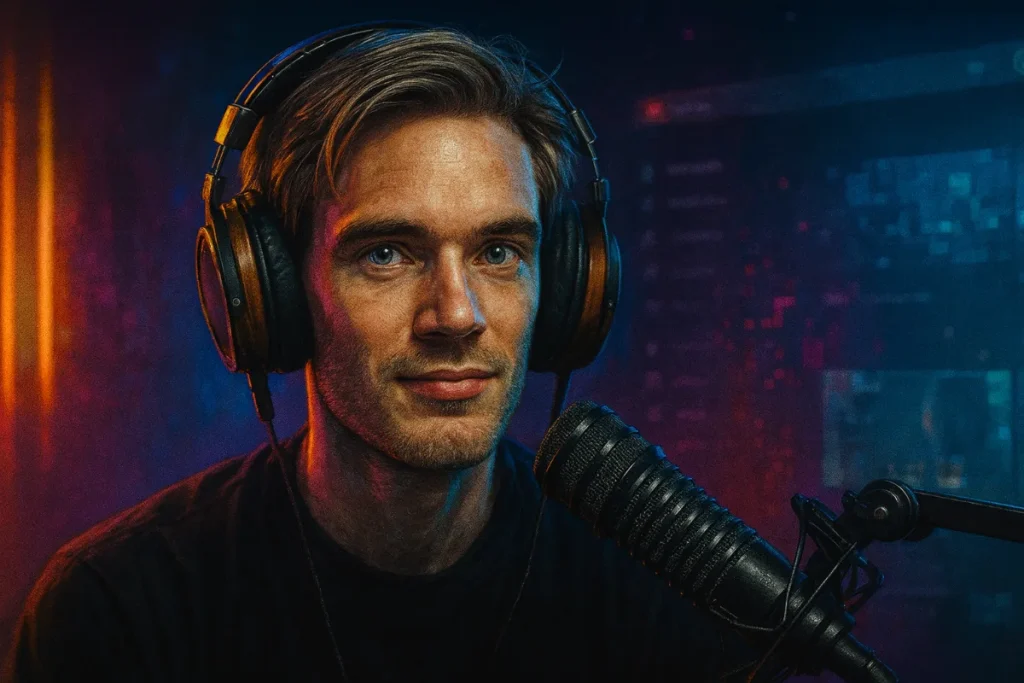
Felix Arvid Ulf Kjellberg was born on October 24, 1989, in Gothenburg, Sweden, to Lotta Kristine Johansson, an information officer, and Ulf Kjellberg, a corporate executive. Growing up in a middle-class household that prized discipline and education, Felix’s creative restlessness quickly set him apart.
He loved drawing characters from Mario and Donkey Kong Country 2 on his Super Nintendo, often losing hours to the glow of pixelated worlds. “Sweden has a great culture around gaming,” he later told Rolling Stone in 2015. “We’re really nerdy people.”
At Göteborgs Högre Samskola, he was bright but easily distracted, far more inspired by art and computer science than economics. After graduating, he enrolled at Chalmers University of Technology, studying Industrial Economics and Technology Management. But formal education felt hollow to him.
By 2010, while most classmates were building resumes, Felix was editing gaming clips on an aging PC. He left Chalmers in 2011 — to his parents’ disbelief — and started selling hot dogs to afford camera gear. It was a risk that would redefine digital entertainment.
Who Is Felix Kjellberg? The Personality Behind PewDiePie
Finding His Voice on YouTube: The Early Years (2010–2012)
Felix launched his YouTube channel PewDiePie in April 2010 after losing access to his first account, “PewDie.” The name came from pew (the sound of lasers) and die, the gamer’s inevitable fate.
His early videos — shaky recordings of Minecraft and Amnesia: The Dark Descent — were raw but authentic. What audiences noticed wasn’t production polish; it was the personality. He shouted, laughed, swore, and thanked viewers as if they were friends sitting beside him.
The “Let’s Play” format already existed, but PewDiePie’s blend of humor + fear + empathy made it viral. Viewers tuned in not for the game, but for Felix’s chaotic charm. By mid-2012 he hit 1 million subscribers; six months later, 2 million. That same year he signed with Maker Studios, the Disney-owned network that turned independent creators into full-fledged media stars.
Felix Kjellberg’s Rise to Global Fame (2013–2016)
On August 15, 2013, PewDiePie became the most-subscribed YouTube channel in the world, surpassing Smosh. His audience — affectionately known as “the Bros” — helped him earn more monthly views than most TV networks.
According to Forbes, by 2014 he was making over $12 million a year through ad revenue, sponsorships, and his book This Book Loves You.
Yet beyond numbers, Felix had tapped into something bigger: a cultural shift.
“The camera became his living room,” wrote The Guardian in a 2016 profile. “He wasn’t acting for the internet; he was living on it.” His catchphrases, chaotic edits, and open gratitude turned one-way broadcasting into a dialogue.
That same openness made him the first YouTuber to bridge fan intimacy with celebrity scale. Variety called him “the most powerful entertainer of his generation — one who built an empire without ever leaving his room.”
Reinvention and Growth: Felix Kjellberg’s Creative Evolution (2017–2019)
Success brought scrutiny. In 2017, The Wall Street Journal compiled clips featuring anti-Semitic humor from his videos. Disney’s Maker Studios dropped him; YouTube suspended his Scare PewDiePie series. Felix apologized, acknowledging his “stupid jokes,” while condemning sensational reporting.
Later that year, he used a racial slur during a live stream of PUBG. Again, he faced backlash, posting a remorseful video titled “My Response.”
Rather than vanish, Felix evolved. He retired his exaggerated “screaming gamer” persona and rebuilt his content around meme reviews, cultural commentary, and self-deprecating humor.
This rebirth coincided with the legendary PewDiePie vs T-Series rivalry (2018 – 2019), a symbolic duel between individual creativity and corporate media. Fans around the world spammed “Subscribe to PewDiePie” as a global inside joke. Though T-Series ultimately surpassed him, PewDiePie’s subscriber war united an online generation.
That same year, he married Marzia Bisognin, his long-time partner from Italy. They met in 2011 when she emailed him after discovering his videos; their relationship blossomed through long-distance calls before they finally settled in Brighton, England — drawn by its quiet atmosphere and high-speed internet. Their two pugs, Maya and Edgar, soon became mascots of the channel.

Life Beyond YouTube: Family, Marriage, and New Beginnings in Japan

By 2020, Felix had outgrown the need to chase trends. He openly discussed burnout, mental health, and the illusion of algorithmic success. “YouTube became my job, not my passion,” he admitted in a video cited by Insider.
In 2022, he and Marzia fulfilled a long-planned dream: moving to Japan. The relocation signaled a shift from constant uploads to intentional creation — videos about minimalism, travel, and personal reflection.
In 2023, they welcomed their first child, marking a new chapter of grounded happiness. “Fatherhood is the first algorithm that doesn’t care about views,” he joked in a Business Insider interview.
Even with fewer posts, PewDiePie remains one of the most-watched individual creators, surpassing 111 million subscribers and 29 billion views. The BBC described him as “a pioneer who helped legitimize YouTube as the new mainstream.”
Achievements That Defined Felix Kjellberg’s Career
- Most-subscribed individual creator on YouTube (2013 – 2019)
- First creator to surpass 100 million subscribers (2019)
- Featured in TIME 100 Most Influential People (2016)
- Forbes 30 Under 30 Europe – Media & Entertainment (2016)
- Recipient of YouTube Diamond and Red Diamond Play Buttons
- Host of YouTube Red series Scare PewDiePie (2016) produced by Robert Kirkman
- Co-founder of sustainable fashion brand Tsuki Market (2018)
- Charity impact exceeding $1 million USD for organizations like Save the Children, Charity: Water, and World Wildlife Fund
Lessons from Fame: Challenges, Criticism, and Comebacks
Felix’s journey embodies both the promise and peril of unfiltered media.
Cultural missteps (2012 – 2017): early humor reliant on shock value aged poorly, forcing him to publicly confront accountability.
Media scrutiny: his conflicts with legacy outlets exposed the gap between old media’s gatekeeping and YouTube’s anarchic openness.
Creative burnout: years of daily uploads blurred the line between authenticity and obligation.
Platform pressures: algorithmic shifts repeatedly affected his reach and monetization.
Through it all, Felix’s greatest resilience lay in transparency. Each setback became content; each apology, a lesson in growth. The Guardian summarized his evolution best: “PewDiePie turned mistakes into milestones — learning in public, and letting millions learn with him.”
The World of Felix Kjellberg: Fun Facts, Quotes, and Everyday Life
Felix and Marzia Kjellberg live privately in Japan with their son and pets. Outside YouTube, he enjoys architecture, sailing, and Japanese art aesthetics.
Trivia
- Sold hot dogs to buy his first recording equipment.
- Previously worked as a harbor captain and tennis assistant.
- Fluent in Swedish and English; studying Japanese.
- One of the first creators to disable YouTube comments (2014) to combat spam — a move later adopted by major channels.
- Donated hundreds of thousands through fan-funded charity drives.
Quotes
“I just want to entertain — that’s my main objective and what comes before everything else.”
“Don’t be a salad, be the best damn broccoli you can be.”
“When something is important enough, you do it even if the odds are not in your favor.”
“I’d rather fail being myself than succeed pretending to be someone else.”
Felix Kjellberg’s Legacy – How One Creator Shaped a Generation
Felix Kjellberg’s impact stretches beyond subscriber counts. He democratized entertainment, proving that a person with a webcam could out-influence television. His channel helped define the creator economy, inspiring entire generations of vloggers, gamers, and streamers.
As Variety noted, “He changed not only YouTube, but the relationship between audience and artist.” Forbes described him as “a case study in monetizing authenticity.”
Today, PewDiePie stands as both a symbol and a lesson — that digital fame requires not perfection, but perseverance. His arc from rebellious gamer to reflective father mirrors the internet’s own coming-of-age.
In the curated archives of Profilia Digital Era Biographies, Felix Kjellberg’s story remains one of bold creativity, fallibility, and evolution — a portrait of how humor, vulnerability, and connection reshaped global media.