Winston Leonard Spencer Churchill was born on November 30, 1874, in Blenheim Palace, Oxfordshire, England — a grand beginning for a boy destined to live a life larger than history itself. His father, Lord Randolph Churchill, was a brilliant but volatile politician, while his mother, Jennie Jerome, was a spirited American socialite whose independence and flair shaped his own.
Churchill’s childhood wasn’t gilded despite the aristocracy. Sent away to boarding school, he often felt lonely and misunderstood. Yet, in that isolation, a fire began to grow — one fueled by defiance and determination. His teachers saw rebellion; history would later call it resilience. He was fascinated by words and war alike, reciting poetry one day and studying battles the next.
When he joined the British Army in the 1890s, Churchill wasn’t just a soldier — he was a storyteller. His dispatches from Cuba, India, Sudan, and South Africa revealed both his courage and his flair for drama. Even then, he was building his legend sentence by sentence, victory by victory.
From Parliament’s Shadows to the Nation’s Spotlight
By his mid-twenties, Churchill had entered Parliament, determined to make his mark. He switched political parties more than once — a move that baffled his peers but underscored his independence of mind. His words, sharp as bayonets, both inspired and infuriated. He spoke with a conviction that seemed old-fashioned even in his own time, invoking ideals of duty, courage, and empire.
In the early 20th century, he served in key posts, including First Lord of the Admiralty, where he modernized the Royal Navy and prepared Britain for the storm he sensed was coming. Yet his ambition sometimes outpaced his fortune. The disastrous Gallipoli campaign during World War I nearly ended his career, forcing him into political exile.
But Churchill was never one to retreat for long. He wrote, painted, reflected — but never stopped preparing. He once said, “Success is not final, failure is not fatal: it is the courage to continue that counts.” It was a lesson he would soon live on the world’s greatest stage.
The Darkest Hour and the Roar of Defiance
When Adolf Hitler’s armies marched across Europe, Britain found itself facing annihilation. By 1940, with France fallen and the Luftwaffe looming overhead, Churchill was appointed Prime Minister — the nation’s last line of defense.
He met terror with thunder. Standing before Parliament, his voice rasping with conviction, he promised not peace but perseverance: “We shall fight on the beaches, we shall fight on the landing grounds, we shall fight in the fields and in the streets…” The words became more than rhetoric — they became armor for a weary nation.
Churchill transformed fear into fortitude. His speeches, carried over radio waves into bomb shelters and living rooms, were a lifeline. He embodied the stubborn courage of a people who refused to bow. Though Britain stood alone for years, his leadership turned despair into defiance, and defiance into victory.
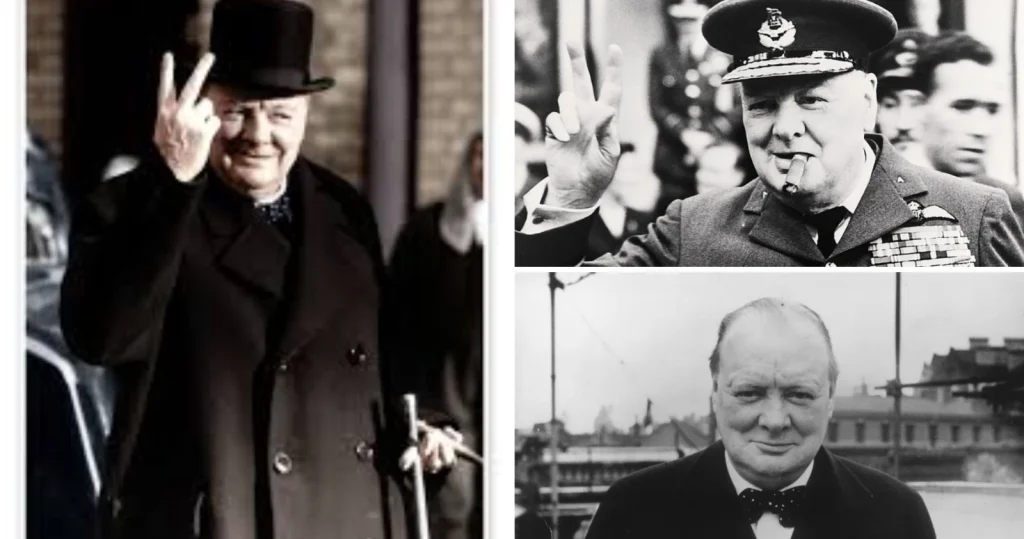
The cigar, the V-sign, the rumbling voice — all became symbols of resistance. But beneath the image was a man who knew doubt and sorrow, who cried in private even as he inspired millions in public.
After the War: Triumph, Isolation, and Reflection
Victory brought Churchill global acclaim — but also political rejection. In 1945, only months after leading Britain to triumph, he was voted out of office. For many, it was an unthinkable twist of fate. But for Churchill, it was another campaign to fight.
He turned to writing and painting, seeking solace in creativity. His speeches across the Atlantic warned of a new menace — the “Iron Curtain” dividing Europe. Decades before others, he foresaw the Cold War. When he returned to power in 1951, he governed with wisdom shaped by age, though his health was fading.
In 1953, he received the Nobel Prize in Literature — not for political theory, but for his mastery of language and history. His six-volume series The Second World War remains one of the most important works of 20th-century history, written by the very man who shaped it.
The Human Beneath the Hero
Behind the defiant speeches stood a complex man — proud, impulsive, emotional, and deeply human. Churchill adored his wife, Clementine, whose steady counsel often softened his temper and grounded his ego. He loved fine cigars, strong whisky, and painting landscapes at his home in Chartwell, where he found peace from the noise of the world.
He suffered bouts of what he called his “black dog” — a melancholy that haunted him for decades. Yet he learned to live with it, not deny it. His humor, warmth, and eccentric charm often hid the weight he carried.
To those who worked with him, he was both exasperating and unforgettable — a man of contradictions: poet and warrior, aristocrat and populist, realist and romantic.
The Legacy That Outlives the Era
Winston Churchill passed away on January 24, 1965 — seventy years to the day after his father’s death. Britain mourned him with one of the largest state funerals in history. As his coffin sailed down the River Thames, cranes along the dockyards dipped their arms in salute. It was a farewell worthy of an empire’s last lion.
His legacy remains vast. Churchill didn’t just lead a nation; he gave it the courage to believe in itself when belief was all that was left. His words shaped the moral vocabulary of the modern world, reminding generations that leadership is not about perfection, but persistence.
Winston Churchill will forever stand as proof that language can be as mighty as any army — and that sometimes, victory begins with the refusal to give in.