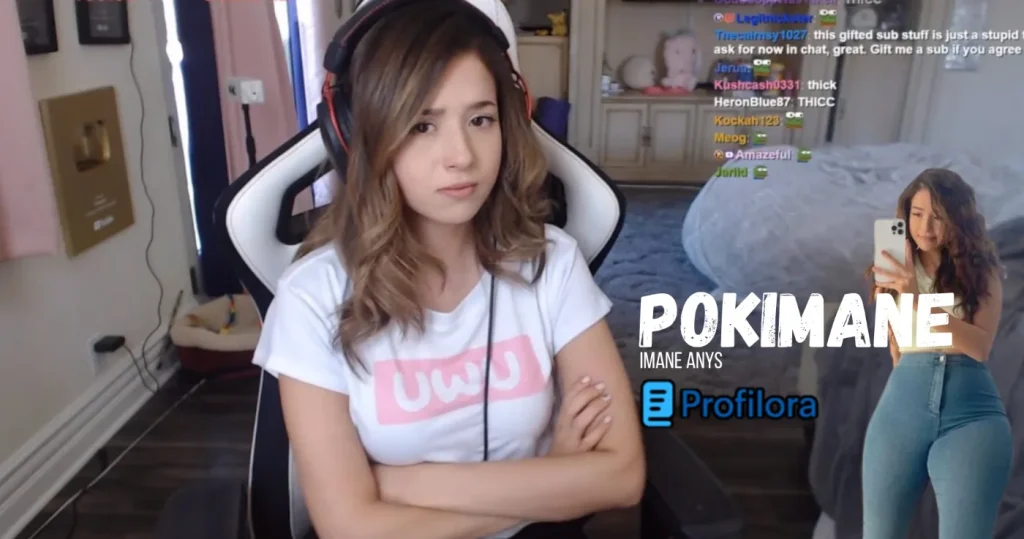
Imane Anys—better known as Pokimane—didn’t become famous by acting larger than life. Her rise came from the opposite instinct: making millions of viewers feel like they were simply hanging out with someone real. In a world where online attention is loud, fast, and often cruel, she built something quieter: consistency, warmth, and a sense of community that kept people coming back long after the hype cycles moved on.
Searches like pokimane twitch, pokimane instagram, or pokimane twitter often start as curiosity. But they usually end in the same realization: this is a creator who didn’t just ride the streaming wave—she helped define what “top streamer” could mean.
A Childhood Between Worlds, and the First Spark
Pokimane was born in 1996 in Morocco and later grew up in Canada. That cross-cultural upbringing mattered. It shaped the way she moved through public life—careful with what she shares, precise with boundaries, and fluent in the subtle art of adapting to different rooms.
Before the internet knew her as a headline, she was a student with a fairly “normal” path on paper. She attended McMaster University and studied chemical engineering, a demanding track that doesn’t leave much space for improvisation. Yet the early pull of online creation was already there: the thrill of being live, the feedback loop of chat, the strange intimacy of talking to strangers who somehow start to feel familiar.
That first spark wasn’t about chasing fame. It was about finding a place where personality could be a craft—and where building a community could be its own kind of work.
When Twitch Became a Stage, Not a Hobby
The “origin story” of Pokimane Twitch isn’t one viral moment. It’s a slow accumulation—streams that got slightly better, slightly sharper, slightly more confident. Over time, people didn’t just tune in for a specific game. They tuned in for her.
Early on, she became known through game content and the broader live-streaming culture that rewards quick reactions and genuine presence. She wasn’t trying to be the most intense competitor in the room. She leaned into something more durable: humor, banter, and a vibe that felt like a friend’s room rather than a performance.
That approach sounds simple until you realize how hard it is to sustain. Streaming is repetition under a spotlight. Show up. Be “on.” Handle chat. Keep energy. Keep boundaries. Do it again tomorrow. It’s a job that asks for authenticity while also punishing it.
And yet, she kept growing.
The Turning Point: From Popular Streamer to Culture Figure
At a certain point, “successful streamer” became an understatement. Pokimane moved into a tier where online creators stop being niche entertainers and start becoming cultural references—quoted, debated, imitated, and sometimes targeted.
Her influence expanded across platforms. Pokimane Instagram became a curated extension of her public image. Pokimane Twitter turned into a place where she could be witty, direct, and occasionally tired in a way that many fans found relatable. She wasn’t just broadcasting; she was shaping how creator identity could look across the internet’s biggest stages.
With that visibility came a new layer of meaning: she became one of the most recognizable women in streaming, and that carries weight—both empowering and exhausting. When an industry is still learning how to treat women fairly, every major female creator becomes, unfairly, a symbol. People project. People nitpick. People form opinions without evidence and call it “analysis.”
Pokimane didn’t simply survive that pressure. She adjusted to it. She learned how to be present without being fully accessible—an important skill in a career where the audience can confuse “closeness” with entitlement.
Beyond the Spotlight: Scrutiny, Boundaries, and Internet Myths
No major internet career comes without turbulence. For Pokimane, the challenges weren’t only professional—they were structural. The culture around streaming has a habit of turning women into discourse: their success becomes suspicious, their appearance becomes public property, and their private life becomes a rumor factory.
That’s why searches like pokimane no makeup or pokimane ethnicity show up so often. The curiosity isn’t always innocent. Sometimes it’s the internet’s old habit of auditing women: how they look, where they come from, whether they “deserve” what they have.
Pokimane has addressed, indirectly and directly, how exhausting that can be. The “no makeup” moment became a strange cultural flashpoint because it revealed something uncomfortable: viewers often demand authenticity, but only the version they personally find convenient. When she appeared without makeup, some people praised her for being real. Others attacked her for looking… human. Both reactions proved the same point: visibility comes with judgment.
There have also been recurring questions around her content history—like why she deleted certain older videos, including some ASMR-related content. Internet audiences love tidy explanations, but creators don’t always owe a full breakdown. Content gets removed for many reasons: changing boundaries, evolving brand direction, privacy concerns, or simply deciding that older work no longer represents who they are. The deeper truth is simpler: long careers require editing, and public figures rarely get to do that quietly.
Even “simple” facts become magnets for debate. Searches like pokimane height or pokimane age reflect how the internet tries to reduce complex people into trivia. She’s a public figure, yes—but she’s also someone who built a career through personality, not mystery. The irony is that the more visible someone is, the more people try to fill gaps with speculation.
The Human Behind the Handle
What makes Pokimane last isn’t just popularity. It’s tone. She has a style of presence that balances warmth and control—friendly, but not performatively open. That matters in streaming, where parasocial relationships can get messy fast.
Her public persona has always included a kind of emotional intelligence: knowing when to joke, when to disengage, when to set a boundary without turning it into a spectacle. There’s a reason her community tends to describe her as comforting. Comfort, online, is underrated—and surprisingly rare.
She’s also part of a generation of creators who understand that the brand isn’t only the content. The brand is the consistency: how you treat people, how you react under pressure, how you respond to controversy, how you protect your mental health while still showing up.
And while fans constantly ask about traditional celebrity territory—pokimane movies and tv shows, for example—the more telling detail is that her career has never needed Hollywood validation to feel legitimate. Streaming became its own industry, with its own stars and its own power. Pokimane helped prove that.
A Legacy Built in Real Time
Pokimane’s legacy isn’t just “one of the biggest streamers.” It’s more specific than that: she helped shape the modern template for a mainstream, platform-spanning creator—one who can be funny and polished, approachable and guarded, present and still in control of her own life.
She also helped normalize the idea that women in gaming and streaming don’t have to fit a single role. Not a mascot. Not a stereotype. Not a punchline. A professional.
And maybe that’s the most lasting impact: she made it easier for the next wave to exist without constantly proving they belong. She didn’t only grow an audience. She expanded the space.
In a culture that loves to treat creators like disposable trends, Imane Anys (Pokimane) built something sturdier: a career that feels less like a viral accident and more like a long, deliberate run.