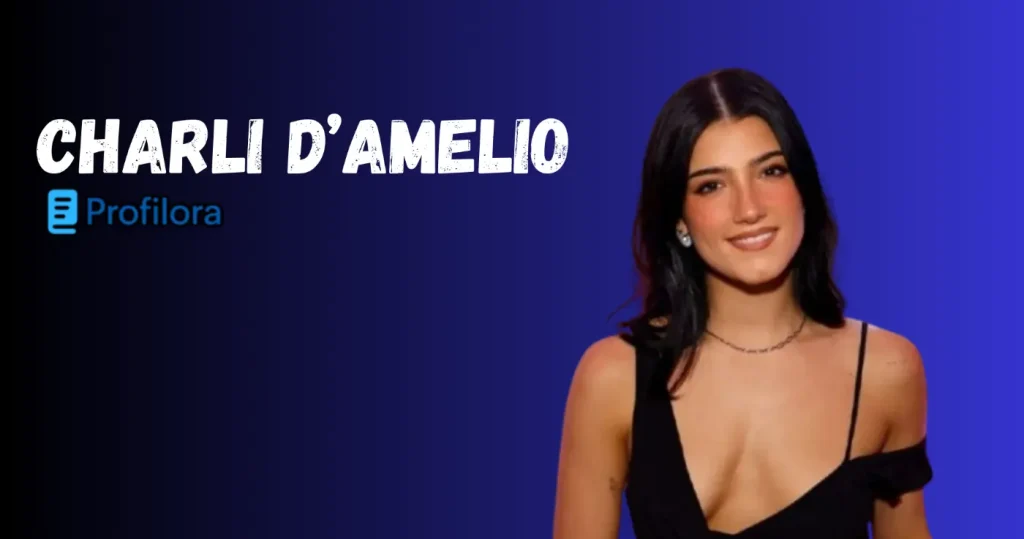
Charli D’Amelio’s story doesn’t begin with a red carpet. It begins with repetition: the quiet discipline of a child learning choreography before she could fully explain why it mattered. Long before the world attached “TikTok star” to her name, she was simply a dancer—counting beats, chasing precision, and finding comfort in movement.
Then the internet arrived with its strange kind of lightning. A few seconds of dance, filmed casually, became a doorway. What followed was not just fame, but a crash course in modern celebrity: the way audiences can adore you, misunderstand you, punish you, and still expect you to keep smiling through the noise. Charli D’Amelio grew up inside that storm—and, over time, learned how to build something sturdier than virality.
A Childhood Measured in Eight Counts
Charli Grace D’Amelio was born on May 1, 2004, in Norwalk, Connecticut. Her home life carried both creativity and ambition: a mother with experience in modeling and photography, and a father rooted in business and public life. She grew up with an older sister, Dixie—someone who would later stand beside her not only as family, but as a public counterpart in a shared spotlight.
Dance came early, the way certain callings do. She began dancing at the age of three and spent years as a competitive dancer, training long before anyone outside her community knew her name. There’s a particular kind of patience in that world: the slow accumulation of skill, the acceptance that improvement is earned in small, unseen increments.
School, too, was part of the early structure. She attended a private school in Stamford, Connecticut, before shifting to virtual learning once her online popularity rewired her daily reality. It’s an abrupt transition—one day a teenager with routines, the next a teenager with a global audience. For someone whose identity was built in studios and classrooms, the sudden scale of attention could only feel unreal.
When the Algorithm Found the Dancer
In May 2019, Charli started posting on TikTok—initially like many teenagers do, experimenting without a master plan. A lip-sync video with a friend was an ordinary start, the kind that disappears into the platform’s endless scroll. But the platform has its own logic, and in July 2019 a duet-style video began to gain traction.
Her rise has often been described as bewilderingly fast, and even she admitted as much. In an interview quoted in coverage of her early fame, she said, “I consider myself a normal teenager that a lot of people watch, for some reason.” That line captures the strange disconnect of internet stardom: a person can feel unchanged while the world insists they’ve become something else.
What made her content resonate was deceptively simple—dance videos set to trending songs—yet the simplicity was part of the appeal. Viewers didn’t just watch a performance; they watched someone who looked like a “normal” teen, moving with the polish of a trained dancer, inside a medium that usually rewards spontaneity over craft.
By late 2019, she had joined The Hype House, a collaborative creator collective that amplified its members through proximity and constant output. Representation followed. She was signed by a management company and, soon after, her family signed with a major talent agency. The shift was clear: this wasn’t only a social media chapter anymore. It was a career being built in real time.
The Renegade Moment, and the Lesson That Followed
A turning point arrived in October 2019, when Charli’s videos performing the dance known as the “Renegade” helped propel it across TikTok at massive scale. The moment was bigger than a trend. It was a proof-of-concept for an era: dances could travel globally in days, and a teenager could become the face of that movement without ever stepping onto a traditional stage.
But the same speed that creates icons also creates friction. As the “Renegade” exploded, Charli received attention that sometimes treated her like the creator of the dance—even though the choreography originated with dancer Jalaiah Harmon. When reporting clarified the origin, backlash followed, and Charli began regularly crediting dance creators going forward.
It was an early public lesson in how internet fame can blur authorship. It also showed something important about her trajectory: she wasn’t only becoming famous; she was learning, under pressure, what responsibility looks like in a culture that often forgets to reward the people who build the art in the first place.
That period also pushed her into mainstream visibility. She appeared in major promotional moments, including a Super Bowl commercial, and participated in campaigns tied to social good—like an anti-bullying initiative with UNICEF and a widely seen social distancing challenge during the pandemic era. She wasn’t merely “a girl who dances online” anymore; she was becoming a symbol of what the creator economy could produce when attention and opportunity collide.
When the Spotlight Turned Harsh
For every story of rapid ascent, there’s an equal story of scrutiny. In late 2020, Charli and her sister faced a wave of backlash after a family dinner video circulated online and viewers interpreted moments as disrespectful toward their chef. The reaction escalated into a familiar internet pattern: outrage, ridicule, and moral certainty delivered at high volume.
Charli addressed the situation publicly, describing the chaos as a misunderstanding while also confronting the intensity of the response—including threats. The internet loves clean narratives, and real humans rarely fit them. What looked like a few awkward seconds on camera turned into a referendum on character.
Around the same period, she was criticized for travel during the pandemic after earlier messaging suggested staying home was important. And like many public figures whose rise depends on platform metrics, she faced speculation and accusations about follower authenticity.
These moments matter not because they define her as “controversial,” but because they reveal the conditions of modern fame: constant visibility, permanent judgment, and an expectation that teenagers should behave like seasoned public diplomats.
The harder truth sits beneath the headlines. Charli has spoken openly about body image struggles and an eating disorder, and about how cruel online comments can be when they focus on appearance. In a UNICEF anti-bullying context, she described how remarks about her body hit close to home, referencing the emotional weight of body dysmorphia and unhealthy habits. In an economy built on being watched, it’s easy to forget the toll of being watched.
A Career Built Beyond One App
The interesting twist in Charli D’Amelio’s biography is that she didn’t remain trapped inside the box people built for her. She moved outward—into television, music, fashion, business, and even the discipline-heavy world of competitive dance on a national stage.
She made an early film appearance through voice work in the animated feature StarDog and TurboCat. She and her family starred in a Hulu docuseries, The D’Amelio Show, and she co-led the Snap series Charli vs. Dixie, which turned sibling competition into philanthropic stakes.
Brand partnerships followed the logic of her influence: a makeup line, nail polish collaborations, fashion partnerships, and products that carried her name from screens into stores. Some deals were flashy; others were quietly strategic. Over time, the arc became clearer—less “endorsement roulette,” more intentional ecosystem-building.
A defining mainstream milestone arrived when she competed on Dancing with the Stars and won Season 31 alongside professional dancer Mark Ballas. That victory mattered because it anchored her identity where it began: dance. Not the looping choreography of trends, but the demanding, judged, old-school grind of performance—where timing, stamina, and technique can’t be faked.
Later, she stepped into theater, making her Broadway debut in the ensemble of & Juliet in a dance-heavy role. It’s a different kind of spotlight—less viral, more traditional, and built on showing up night after night. For someone who became famous in seconds, Broadway asks for endurance.
She also leaned into entrepreneurship. The D’Amelio family launched a multi-product company and expanded into categories like fashion, beauty, and food. On the investment side, she participated in funding rounds and was involved in a venture capital fund designed to back companies—particularly those led by women and minority founders. This part of her story isn’t as glamorous as a trending dance, but it’s often the part that lasts longest: building structures that remain even after attention shifts.
The Legacy That Outlives the Feed
Charli D’Amelio’s legacy sits at the intersection of dance, internet culture, and the modern creator economy. She helped define what it looks like when a teenager becomes a global media figure without passing through the old gatekeepers. That alone reshaped expectations—not just for influencers, but for brands, agencies, networks, and anyone trying to understand where culture forms now.
Yet her story also carries warnings: about how quickly audiences can turn, how fragile public perception is, and how unforgiving the internet can be toward young women in particular. She learned those lessons in public, and sometimes painfully, and that experience has become part of her cultural meaning.
If her early era proved that TikTok could create stars, her later era suggests something more mature: stars can evolve. They can return to craft, build businesses, take on traditional stages, and keep searching for a life that feels real behind the performance.
In the end, Charli D’Amelio isn’t only a case study in virality. She’s a portrait of growing up under a microscope—and still finding ways to move forward with rhythm, discipline, and a clearer sense of self.